

Radio Callsign: Oscar-Romeo-India-Hotel
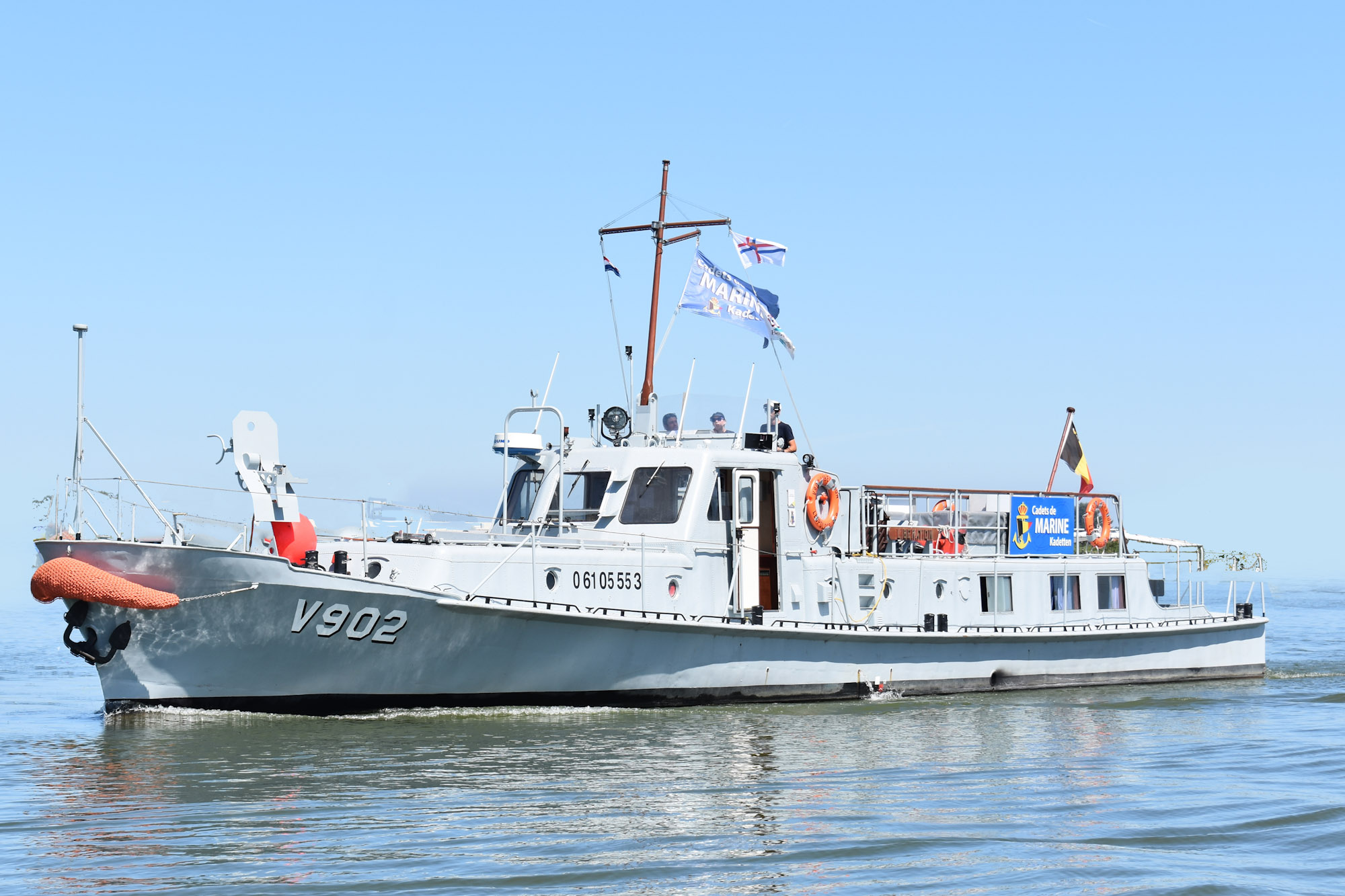
The National Training Ship V902 'Libération'
Flagship of the Royal Sea Cadet Corps
Since 2012, the Royal Sea Cadet Corps has been the proud owner of the patrol boat Libération. Her acquisition followed a long and distinguished career as a Rhine patrol boat with the Belgian Naval Force (now the Navy). Officially recognized as protected maritime heritage, the ship underwent a complete restoration several years ago. Today, the Libération serves as a national training ship, home-ported in Leopoldsburg.
The Rhine Patrol Boats
In the 1950s, the Belgian Army deployed a fleet of fast river patrol boats to patrol the Rhine. In the aftermath of the Second World War, Allied nations maintained oversight of post-war Germany while establishing a buffer against the rising Communist threat along the eastern border. This era initiated a long-term Belgian military presence in West Germany and necessitated the deployment of the Belgian Naval Force to secure German inland waterways.
Due to their shallow draft, these patrol boats (or vedettes) were eminently suited for this mission. The Belgian Maritime Rhine Squadron was established in 1953 in Niehl, near Cologne. The base featured a small floating dry dock, allowing the squadron to perform maintenance autonomously. These vessels patrolled the Rhine between Koblenz and the Dutch border, covering a zone approximately 250 kilometers in length.
In 1953, six identical vessels were launched and named after Belgian rivers: P900 IJzer, P901 Leie, P903 Meuse, P904 Sambre, P905 Schelde, and P906 Semois. A year later, three more units followed with slightly modified superstructures: P907 Rupel, P908 Ourthe, and the Dender (which lacked a hull number). A tenth, slightly larger vessel was designated as the squadron's command ship: the P902 Libération.
The Rhine Squadron was disbanded in 1960, and by 1963, the patrol boats had relocated to the naval base in Kallo. From there, the fleet was utilized for public relations, hydrographic surveys, and research, though their numbers gradually dwindled. The sole survivor, P902 Libération, moved to Zeebrugge in 1989. She remained the property of the Belgian Navy and served as a ceremonial vessel until 2010. In 2012, the Royal Sea Cadet Corps acquired the ship, which was subsequently classified as protected heritage and renamed V902 Libération—the 'V' standing for vedette.
The Design Concept
To succeed in their mission, the Rhine patrol boats required high speeds and the ability to navigate shallow waters near riverbanks. This led to a long, narrow hull with sleek lines, designed to optimize the dissipation of the stern wave at maximum speed. The riveted hull plates were fully faired to ensure a smooth surface, guaranteeing the required performance.
One of the ship's most noteworthy features is the use of aluminum for the deck and superstructure to minimize weight. Since aluminum welding was not yet perfected at the time, the entire structure was riveted. The deck of the Libérationlacks a traditional sheer; instead, it runs from bow to stern in a single, gently curving line. The upper deck features a second helm station, allowing all maneuvers to be executed from outside.
Efficiency guided the interior design, which originally accommodated a crew of seven: a non-commissioned officer (skipper), a radio operator, three deckhands, and two engineers. The engine room occupies the midsection, with the wheelhouse located immediately aft. The forepeak housed Spartan crew quarters, consisting of a small seating area and four bunks. Because the crew stood continuous watches, there was no need for everyone to sleep simultaneously. Between the engine room and the aft deck, the designers placed a small galley, a toilet compartment, and the skipper's cabin, all finished in a functional, utilitarian style.
Propulsion
Originally, all Rhine patrol boats were powered by twin MWM (Motorenwerke Mannheim) diesel engines, each rated at 220 hp. This twin-engine configuration bolstered operational reliability. In 2007, the Libération’s original engines were replaced with more fuel-efficient John Deere units (2 x 305 hp). The original Reintjes reverse reduction gears were also upgraded to Twin Disc units. Today, the ship utilizes electromechanical systems for both gear control and engine speed.
The Cadet Corps and the Rhine Tradition
The Royal Sea Cadet Corps maintains a long tradition of operating these patrol vessels. The Ourthe and Rupel served in Liège and Brussels until 1983, while the Sambre remained active in Brussels until her decommissioning in 2021. Since 2010, the Leie has served as a training vessel for the Leuven division. Managed by the Leopoldsburg division, the Libération remains a prominent sight on Belgian waterways. Beyond her educational role for young cadets, she fulfills a public function by participating in major maritime events such as 'Oostende voor Anker'.
A Mission for the Belgian Navy
In September 2021, the new ensign for the Navy’s auxiliary vessels flew from the Libération's mast for the very first time. She set course for Marchienne-au-Pont to attend the annual "Pardon Batellerie-Plaisance-Marine" in collaboration with the Belgian Navy. Because current naval vessels could not reach the location—due to low clearance beneath the fixed bridges toward Charleroi—the Navy Command deployed the Libération as an auxiliary vessel.
This marked the first time a ship not owned by the Belgian State was authorized to fly the Navy’s auxiliary ensign. As the Belgian Armed Forces look toward future recruitment campaigns, the V902 Libération will continue to be called into service, cementing her status as a true icon of Belgian maritime history.
TECHNICAL SPECIFICATIONS: V902 LIBÉRATION
- Name: Libération
- Hull Number: P902 (until Oct 29, 2012) | V902 (Present)
- Vessel Type: River Patrol Boat (Vedette)
- Shipyard: Theodor Hitzler, Regensburg, Germany
- Keel Laid: March 12, 1954
- Launched: July 29, 1954
- Commissioned: August 24, 1954
- Dimensions: Length: 25.62 m | Beam: 4.28 m | Draft: 0.90 m
- Displacement: 27.5 tons
- Hull Material: Riveted Steel
- Superstructure: Riveted Aluminum
- Engines: 2 x 305 hp John Deere (Refitted 2007)
- Propulsion: 2 Fixed-pitch propellers
- Speed: 19 knots (Maximum)
- Range: 1,900 km at 10 km/h (approx. 1,025 nautical miles)
- Fuel Capacity: 1.5 tons of Diesel
- Crew: 7
- Armament: Originally 2 x .50 caliber machine guns (foredeck & upper deck). Currently unarmed; a replica is mounted on the foredeck for ceremonial purposes.
- Owner: * 1954 – 2012: Belgian Naval Force (Belgian Navy)
- 2012 – Present: Royal Belgian Sea Cadet Corps (NPO)
- Home Port: Leopoldsburg, Belgium


